AI monetization for Balsamiq Cloud
Shipped AI credits first for legacy plans. Then made the pre-launch case to halve what we'd pitched for new per-user plans.
Overview
Balsamiq AI was in beta and included for free, without limits. Rather than bundle AI monetization into the per-user pricing launch, we shipped it first for legacy plans. That let us get the credit system, allocations, and top-ups working in production before layering in a whole new pricing model. What shipped is live at balsamiq.com/pricing.
The credit unit itself came from our engineering team's cost tracking and how Gemini priced each AI interaction. My job was to help with the packaging.
The philosophy that guided everything
A team metaphor kept us grounded: "Electricity, not a parking meter." Most people should never think about the limit. If you're a heavy user, top-ups are there. The baseline doesn't have to cover every edge case; it has to feel like the tool is powering you, not metering you.
What I designed
Per-tier allocations grounded in real usage. For legacy plans, I pulled behavioral data from PostHog on how our early AI users spent credits, ran percentile breakdowns, and set allocations from there. For the new per-user plans, I re-ran the exercise against ground-truth heavy-session data from our AI backend. That's what triggered the call to halve what had been pitched.
Overage packs, not surprise bills. For occasional spikes, users buy one-time top-ups at fair round prices. No pay-per-action anxiety.
Competitive positioning. I benchmarked our AI allowances against comparable tools, such as Lovable and Figma. The decision: sit in the friendly middle. Generous enough to feel like an accelerator, tight enough not to train the wrong expectations.
The judgment moment
The per-user plan credit numbers had been agreed as part of the pricing pitch. But while I was testing the new billing page, they started to feel too big for how our real users work. I pulled ground-truth data from our AI backend, cross-checked against PostHog, and made the case pre-launch to halve the allocations.
Not a common move, going back to change a decision the room had already made. But I had the data.
We shipped with the halved numbers, plus top-ups for the rare heavy sessions, and a 90-day review commitment to adjust either direction if the data said otherwise.
Results
- Balsamiq AI shipped out of beta on March 24, 2026, with credit limits users could trust, on legacy plans.
- Halved per-editor allowances shipped with per-user pricing in May 2026. Live now at balsamiq.com/pricing.
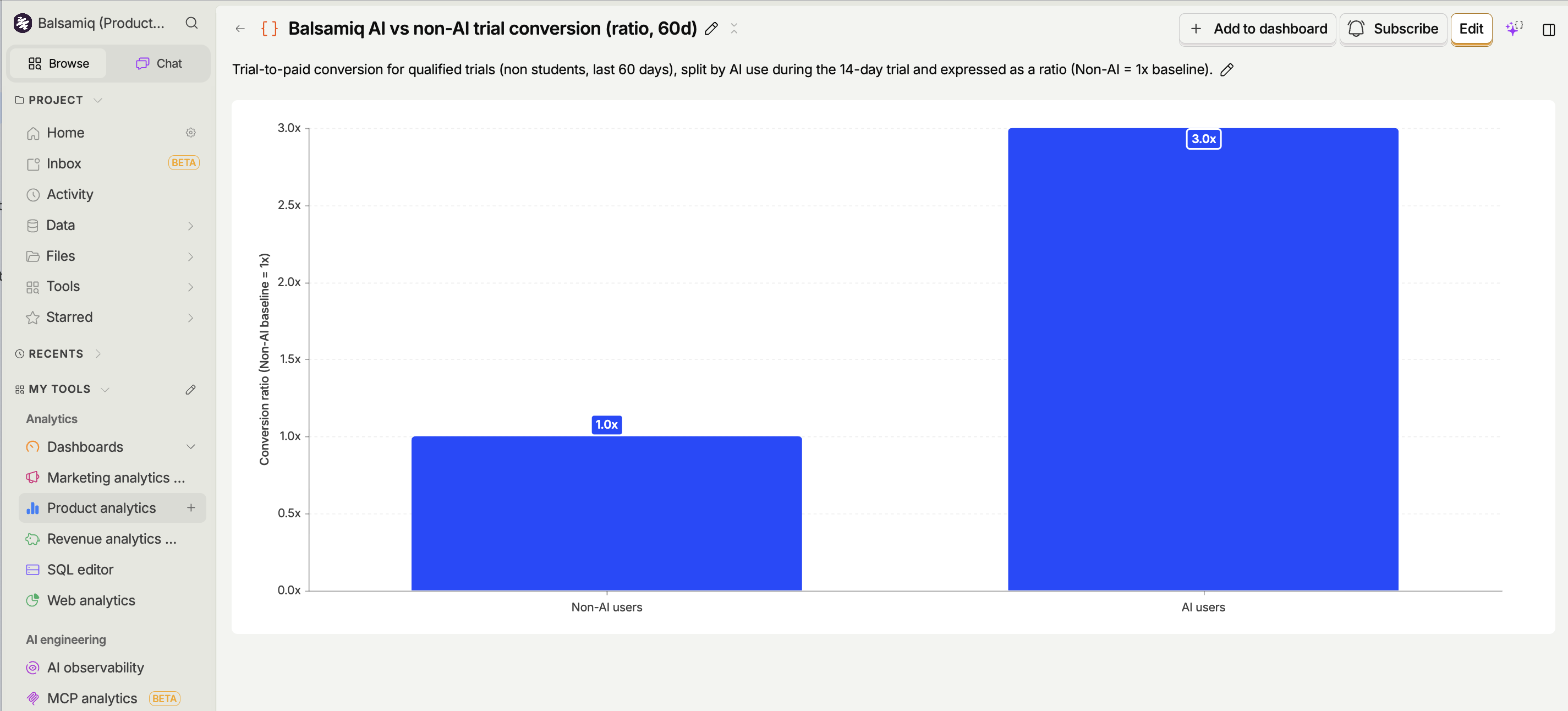
- AI-adopting qualified trial users convert to paid at ~3x the rate of non-adopters (60-day rolling average via PostHog).
- Room aligned across product, engineering, design, and CX.
- 90-day review baked in as safeguard.